Sometimes you unexpectedly find exactly what you are looking for. And it turns out to be even more beautiful than you had hoped.
Magical honey from the Georgikeas family

During our search for the best olive oil in Greece, we spent a wonderful week in Central-East Mani . A region known for its rugged beauty, ancient culture, and pure flavors. The journey from the coast to this pristine area is an experience in itself. Read more about our trip through Mani here.
We followed the trail of a local press that told us about the exceptional olive oil from Jorgos and his family . Year after year, they achieve impressive results here, in an area considered by connoisseurs to be one of the best olive oil regions in the world.
The olive grove turned out to be paradise. And as if that weren't enough, an unexpected discovery awaited us. For over a year, we had been searching for truly good honey in the Kalamata region, but without success. It was only upon arrival at the olive grove that we discovered the family ran a beekeeping operation alongside olive farming . And there, among the trees and mountains, we finally found what we had been looking for for so long.
A hidden treasure in the Mani landscape
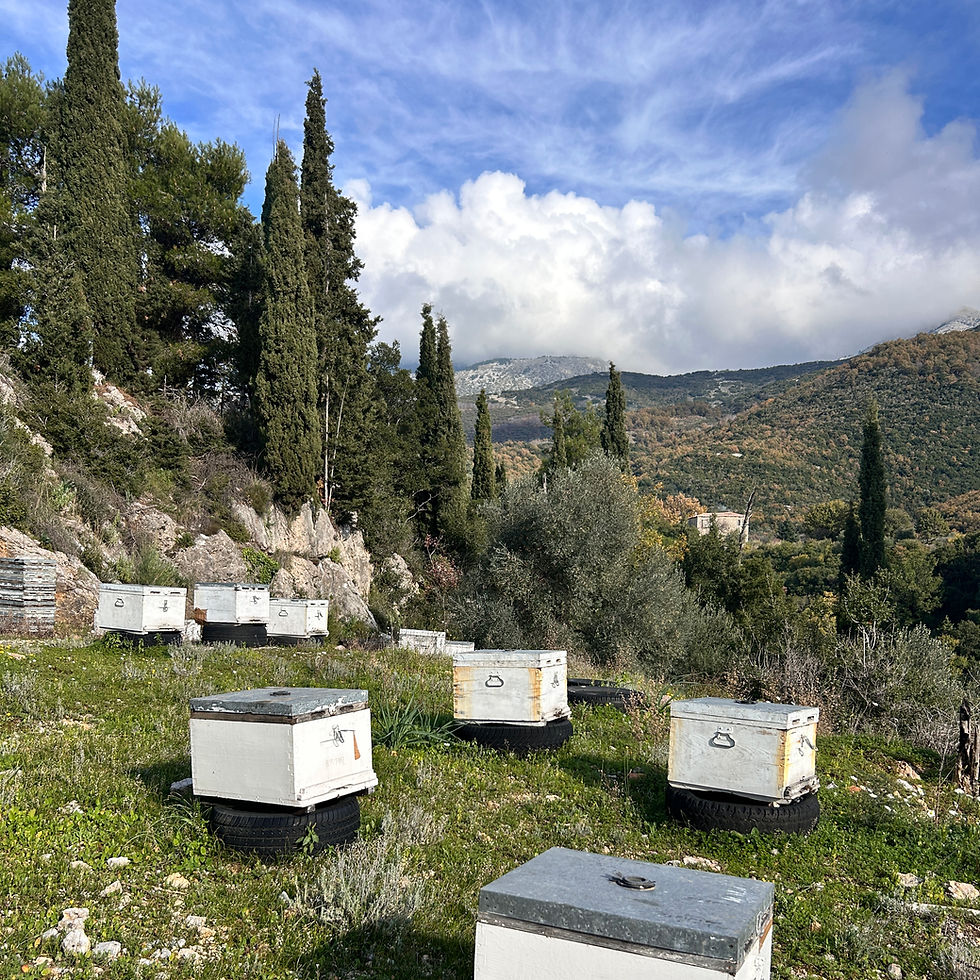
In the middle of the rugged landscape, surrounded by pine forests, mountain herbs, and steep rock formations, we discovered another jewel of nature: the beehives where mountain honey and thyme honey come from.
Upon arrival, we were warmly welcomed by Jorgos, his wife Eirini, and their son Ángelos . They invited us to a simple but delicious picnic in their olive grove. After a meal of homemade bread, olive oil, eggs, olives, and tomatoes, they took us on a tour of their land, where walnut and fig trees grow alongside olive trees.
The life of bees through the seasons
From the olive grove, we walked to an open clearing overlooking the valley and the mountains, where the beehives are set up. It was winter. Although the landscape seemed still, there was plenty of life in the hives.
Winter
It is now winter, and Angelos explained to us that bees do not make new honey in the winter. They live off the food stores they built up during the warmer months and use them to keep the colony alive. Because flowers are scarce during this period, all energy is focused on survival and protecting the hive. The honey we know remains untouched in the combs.
Summer
When flowers are in full bloom in spring and summer, worker bees fly out to collect nectar and pollen. Inside the hive, the nectar is mixed with natural enzymes and given time to ripen slowly, while excess moisture evaporates. This is how that rich, syrupy honey, full of flavor and character, is created step by step.
Angiolos moves the beehives with the seasons. The landscape of Mani is rugged and dry, and flowering never occurs everywhere at the same time. In spring, the hives are placed lower down, where wild herbs and blossoms appear first. During the hot summer months, they are moved higher into the mountains, towards pine forests and cooler slopes, where thyme, sage, and pine honeydew are available. In this way, the bees follow the natural rhythm of Mani and can feed on what the land has to offer at that moment.


Two types of honey, one story
A few days later, we returned to taste the honey. At the home of the Georgian family, a beautiful traditional stone house from 1860 located in the heart of the hamlet next to the church, we found the honey stored in the cool cellar.
There we tasted the result of this beautiful process. The honey is exceptional in taste and texture: rich, full, and silky smooth. Angelos has two types of honey, each with its own character.


Mountain honey
This honey comes from the rugged landscape of Central-East Mani and is harvested in August, when nature is at its most powerful. The bees collect nectar and honeydew from pines and wild mountain herbs such as oregano, mountain tea (Sideritis), thyme, and sage. The result is a dark, spicy honey with a warm, layered flavor and a long finish. Less sweet than floral honey, but full and intense. Unprocessed and unheated, so that aromas, enzymes, and minerals are preserved.
Thyme honey
Thyme honey is lighter in color and has a more pronounced aroma. During the flowering of wild thyme in the summer, bees collect nectar that produces an aromatic, slightly spicy, and floral honey. Elegant, refined, and typically Mediterranean, loved for its gentle sweetness and characterful flavor.
Both types of honey reflect the landscape from which they originate: pure and authentic. No rush, no processing, just time, tradition, and craftsmanship in every jar.


A find to cherish
We left Mani not only with jars of honey, but with the feeling that we had found something special. Finally, honey that is right—in taste, origin, and story. The fact that this particular honey is connected to people, a landscape, and a way of life so close to nature makes it all the more valuable.
Upon parting, we were given a large bag filled with avocados, apples, oranges, and mandarins, delicious homemade walnut and honey cake, and a fantastic feeling. A simple, generous gesture that summed it all up: hospitality, pride, and pure wealth. We are very grateful to have been able to experience this.


